

ContentsStart0%
Why can two passages with no shared keywords point to the same thing?
Suppose someone asks ChatGPT: "How can I improve the chances that my website content is used in AI answers?"
Two passages exist online. The first says: "Generative Engine Optimization (GEO) focuses on improving how visible content is in generated answers." The second says: "If you want a chatbot to cite your article when it answers a question, you need to make the information easy to retrieve and also provide evidence that can support the answer."
The two passages share almost none of their core terms, yet they address the same question. Conversely, another article may repeat "GEO", "ChatGPT" and "AI search" densely and still be nothing more than an overview of industry size, without telling a site owner where to start.
This is the starting point for understanding semantic retrieval: whether a piece of content can be found depends not only on how many words it shares with the query, but also on whether the retrieval system can judge the two to be related in meaning. That does not mean traditional keyword retrieval has retired, and it does not justify concluding that all AI search runs on vectors alone.
Push the question one step further and the real gap appears. Even if an article passes retrieval and enters the candidate list, it may still not be placed in the AI's final answer. And even if the model does use information from the article, the answer may not carry the correct source link. This article unpacks the distance between "semantically similar" and "cited", a distance that is often oversimplified.
How does an embedding turn text into a vector?
Placing text in a coordinate system where direction can be computed
Mathematically, a vector is an ordered list of numbers. A text embedding model (embedding model) maps a sentence, a paragraph or a whole document to a high-dimensional vector, so that the semantic associations the model learned under a given training objective become geometric relationships in a coordinate space.
For intuition, picture the vectors, which have hundreds to thousands of dimensions, compressed onto a two-dimensional plane. Each piece of text is an arrow from the origin. The closer an arrow's direction is to the user's question, the closer the semantic relationship between the two in that model's representation space.
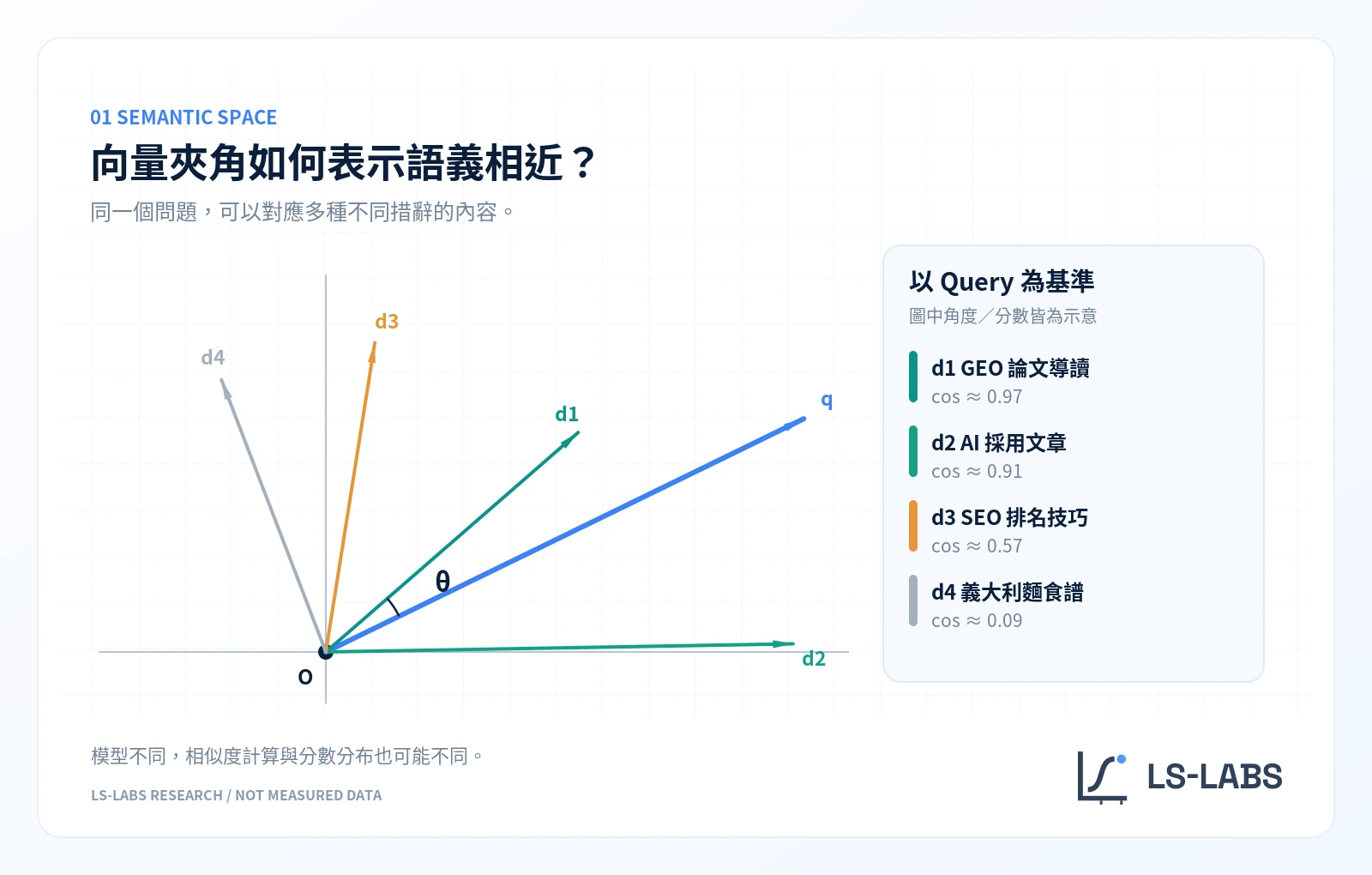
The most common measure of how close two vectors point is cosine similarity:
Cosine similarity formula: cos(θ) = (q · d) / (‖q‖ × ‖d‖)
Here q is the query vector and d is the content vector. The numerator q · d is the dot product of the two vectors, and the denominator ‖q‖ × ‖d‖ is the product of their lengths. The smaller the angle θ, the closer cos(θ) is to 1; at an angle of 90° it equals 0; when the directions are fully opposite (180°) it equals -1.
Read this formula with care. It is a geometric definition and cannot be translated directly into "a score of 1 means synonymous, 0 means unrelated, -1 means opposite". For example, "this restaurant's food is delicious" and "this restaurant's food is terrible" are opposite judgments, yet both revolve around a restaurant and the dining experience, so many semantic embedding models still place them quite close together. Semantic closeness does not mean agreement in stance, and it certainly does not mean factual accuracy.
Why doesn't turning text into numbers automatically produce "meaning"?
Making distances between vectors genuinely reflect sentence-level semantic similarity is itself an important research problem in natural language processing. The Sentence-BERT (SBERT) paper, published at EMNLP in 2019, found that taking raw BERT output that had not been fine-tuned for sentence embeddings and averaging it, or using the [CLS] vector, performed even worse on semantic similarity benchmarks than traditional GloVe word vectors. The researchers therefore retrained sentence embeddings with Siamese and triplet network architectures, so that two passages can be encoded independently and then compared quickly by cosine similarity (Reimers & Gurevych, 2019).
The paper offers a classic comparison of computing costs. On a single NVIDIA V100 GPU, finding the most similar pair among 10,000 sentences with the traditional approach of feeding each pair into a BERT cross-encoder requires 49,995,000 inference passes and takes about 65 hours. With Sentence-BERT, precomputing the sentence embeddings and comparing cosine similarity cuts the total time to about 5 seconds. Because document vectors can be precomputed offline and indexed, semantic matching moved from expensive pairwise inference to scalable online retrieval.
Another practical limitation is often overlooked: vector scores cannot be compared directly across models. Different embedding models differ in training data, loss functions and dimensional distribution. An analysis of BERT, ELMo and GPT-2 by Ethayarajh (2019) further noted that such contextual representations tend to crowd into a narrow cone of the high-dimensional space and are highly anisotropic, so even the cosine similarity of two random, unrelated words can be far above 0. The claim that circulates from time to time, that a paragraph is likely to be cited by AI once its cosine similarity with the question exceeds 0.8, therefore has no scientific basis as a threshold that works across platforms.
How does semantic similarity become a search result?
Where dense retrieval and keyword retrieval complement each other
In information retrieval, dense retrieval maps the user's query and a large collection of document passages into the same vector space, then uses approximate nearest neighbor (ANN) search to quickly recall the top K closest candidate passages (Top-K).
Dense Passage Retrieval (DPR), published at EMNLP in 2020, is the representative work on this path (Karpukhin et al., 2020). DPR uses a dual encoder to process questions and about 21 million 100-word Wikipedia passages separately, and uses the dot product of the vectors as its default relevance function. The dot product equals cosine similarity only if all vectors are first normalized to unit length. In other words, the angle diagram helps build intuition but cannot be treated as the only underlying formula of every retrieval system.
What matters more for marketing and content researchers is the contrast between DPR and the traditional keyword method BM25. On the Natural Questions dataset, built from real search queries, the share of the top 20 recalled passages that contain the answer (top-20 recall) was 78.4% for DPR, clearly higher than 59.1% for BM25. On the SQuAD dataset, where askers largely reuse the wording of the source text, BM25 (68.8%) instead outperformed a DPR not fine-tuned on that set (63.2%), and a hybrid retriever combining the two lifted overall performance further (Karpukhin et al., 2020).
These figures directly dispel the myth that "once you have vector retrieval, you no longer need keywords". Dense retrieval is good at crossing paraphrases and conversational questions, while sparse keyword retrieval keeps a precision advantage on proper nouns, brand names, product model numbers and legal article numbers. Modern search systems commonly combine both, and doing GEO does not require discarding the words and entities that SEO has built up over the years.
AI search often faces a set of expanded sub-questions
Traditional search mostly matches the string the user typed against an index. Generative search often adds a step before retrieval: rewriting and decomposing the query. When explaining AI Overviews and AI Mode, Google Search Central explicitly mentions a query fan-out mechanism: the system breaks a complex question into several related sub-queries issued at the same time, retrieving a broader set of web links across different subtopics and data sources (Google Search Central, n.d.). OpenAI's technical description of ChatGPT Search likewise says the model rewrites the user's question into one or more targeted search queries based on the conversation context.
For example, when a user asks "How do I measure GEO results?", the retrieval directions behind it might include "how is the AI search citation rate calculated", "what is the difference between a brand mention and a source link", and "how do you resample when different models' answers fluctuate". These three sub-questions are teaching examples, but they illustrate one point: an article that merely repeats the words "GEO results" without separately answering metric definitions and sampling limits will struggle to provide effective support across multiple sub-queries at once.
The chunking myth: you don't have to shred an article for AI
Because vector database implementations often split long texts into fixed-size or semantic passages (chunks) before indexing, a dogma emerged for a while that "to do GEO, every paragraph must be written as a short, standalone fragment of a few sentences". This mistakes the engineering defaults of particular development frameworks for a writing rule of every commercial search engine.
Google's official 2026 document "Optimizing your website for generative AI features on Google Search" states directly that site owners do not need to deliberately split content into fragments (chunking) to cater to generative AI, because search systems can already understand multiple related subtopics covered on the same page (Google Search Central, 2026). The approach that serves both human readers and machine retrieval is to give each section a clear subheading, a clear lead conclusion and complete context.
From question to citation: which five gates does content pass through?
Understanding vectors and hybrid retrieval gets you only halfway. The Retrieval-Augmented Generation (RAG) paper, published at NeurIPS in 2020, established the classic paradigm in which a retriever first fetches external documents and a generative model then synthesizes the answer (Lewis et al., 2020). In today's commercial AI search, systems often layer on multiple rounds of querying, quality-signal filtering and after-the-fact citation alignment. The figure below lays out five core conceptual gates to help locate where content gets lost (the actual engineering architecture of each platform may merge steps, iterate on them or omit some):
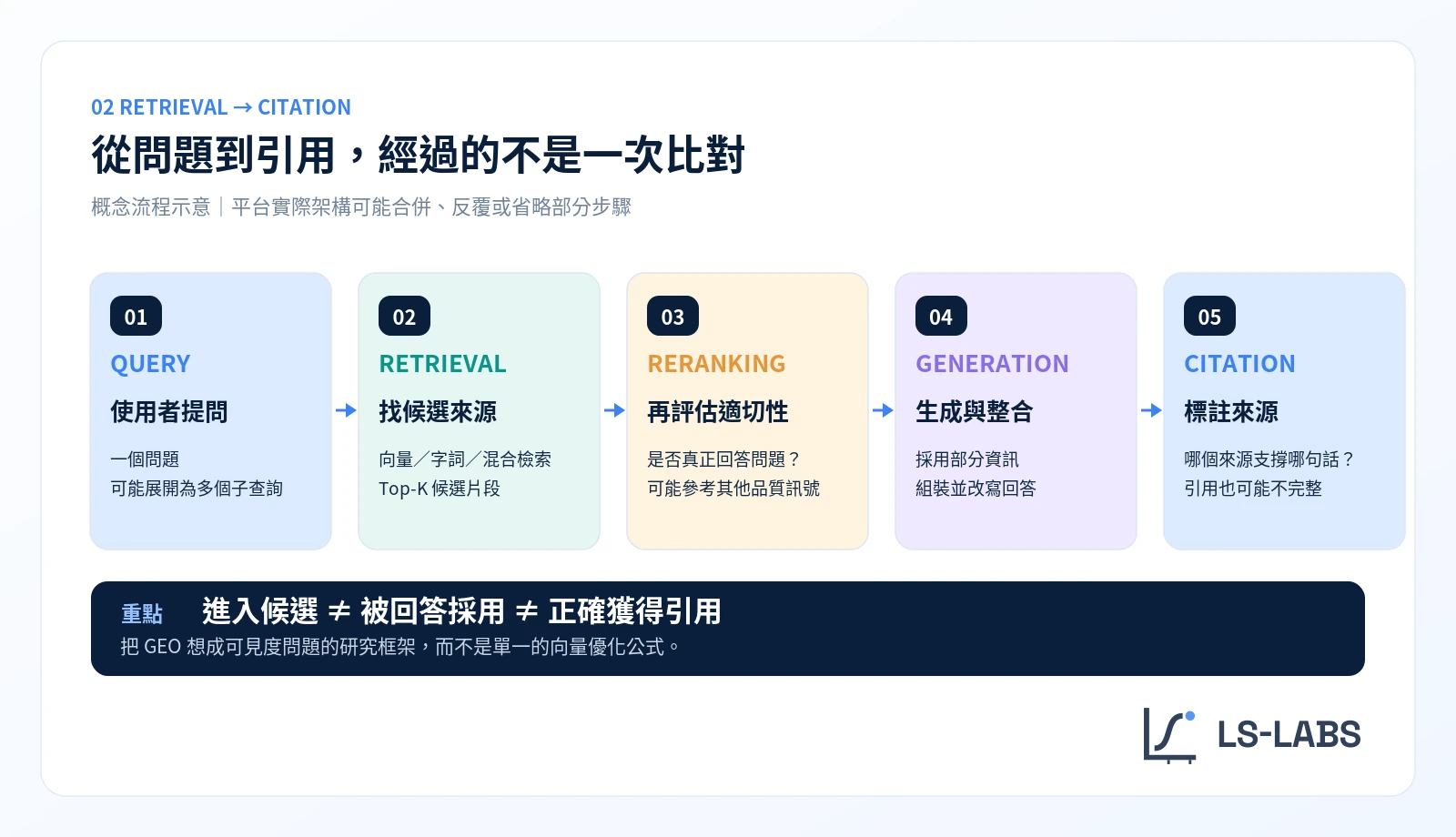
- Query expansion (Query): The system parses the intent of the conversation and rewrites or decomposes the conversational question into one or more search sub-queries. If the question does not need fresh external data, the model may not even trigger web retrieval and may answer straight from its parametric memory.
- Candidate retrieval (Retrieval): The retriever uses term matching, vector similarity or a hybrid index to recall a batch of Top-K candidate snippets from the web pages it can access. A page is eliminated at this gate if it is blocked, not indexed, or unrelated to every sub-query.
- Reranking (Re-ranking): First-pass recall prioritizes speed, so passages that are tangential to the topic but do not answer it directly inevitably slip in. After recall, information retrieval systems often introduce a finer but more computationally expensive cross-encoder, or a model such as ColBERT that keeps token-level late interaction, to rescore the candidates (Khattab & Zaharia, 2020), and they may also take in signals such as site authority and freshness. For example, for the query "how do you measure GEO", an article that spells out metric definitions and sampling design is usually more likely to win at the reranking stage than an overview that talks in general terms about how important GEO trends are.
- Generation and integration (Generation): The dozens of passages that enter the model's context window are not used evenly. A large language model picks the facts, figures and definitions that directly support its argument, then compresses, rewrites and assembles multiple sources into a fluent answer.
- Source citation (Citation): The system attaches links at the end of a sentence or in a source list. Note that the citation list shown on screen does not necessarily map one to one to the passages the model actually relied on while generating: some sentences blend information from several places yet carry a single link, and some links are matched only after the answer has been generated.
With the five gates laid out, the core diagnostic principle of this whole article becomes clear: entering the retrieval candidates, being substantively used by the answer, and receiving a correct citation are three outcomes that must be observed separately.
What did the KDD 2024 GEO paper actually show?
If entering the candidate pool does not guarantee being used, can changing how a web page is written alter its visibility in generated answers?
The landmark paper "GEO: Generative Engine Optimization", published at KDD 2024 by researchers from Princeton University, IIT Delhi, Allen AI and other institutions, was the first to set up a systematic experimental benchmark for this question (Aggarwal et al., 2024). The team built GEO-bench, containing 10,000 diverse queries. For each question they fixed the top five Google Search web sources, then had GPT-3.5-turbo generate an answer with inline citations based on those five sources. In each run, only one target source received a particular content rewriting strategy, so that the change in that source's visibility in the answer could be compared before and after the rewrite.
It is crucial to understand the limits of this design: because the five input sources were fixed in advance, the paper tested "how much candidate content is used at the generation and citation stage", not "whether rewriting can raise a page's ranking in Google or in a retriever", and it cannot be extended directly to claim that every commercial model today adds a fixed bonus in proportion.
Among the paper's subjective and objective evaluations, the most often cited is the word-count and position-weighted metric Position-Adjusted Word Count (which computes the share of the answer's words taken up by sentences citing a source, giving higher weight to sentences that appear earlier). Figure 3 and Table 1 summarize the core results of Table 1 in the arXiv v3 version of the paper:
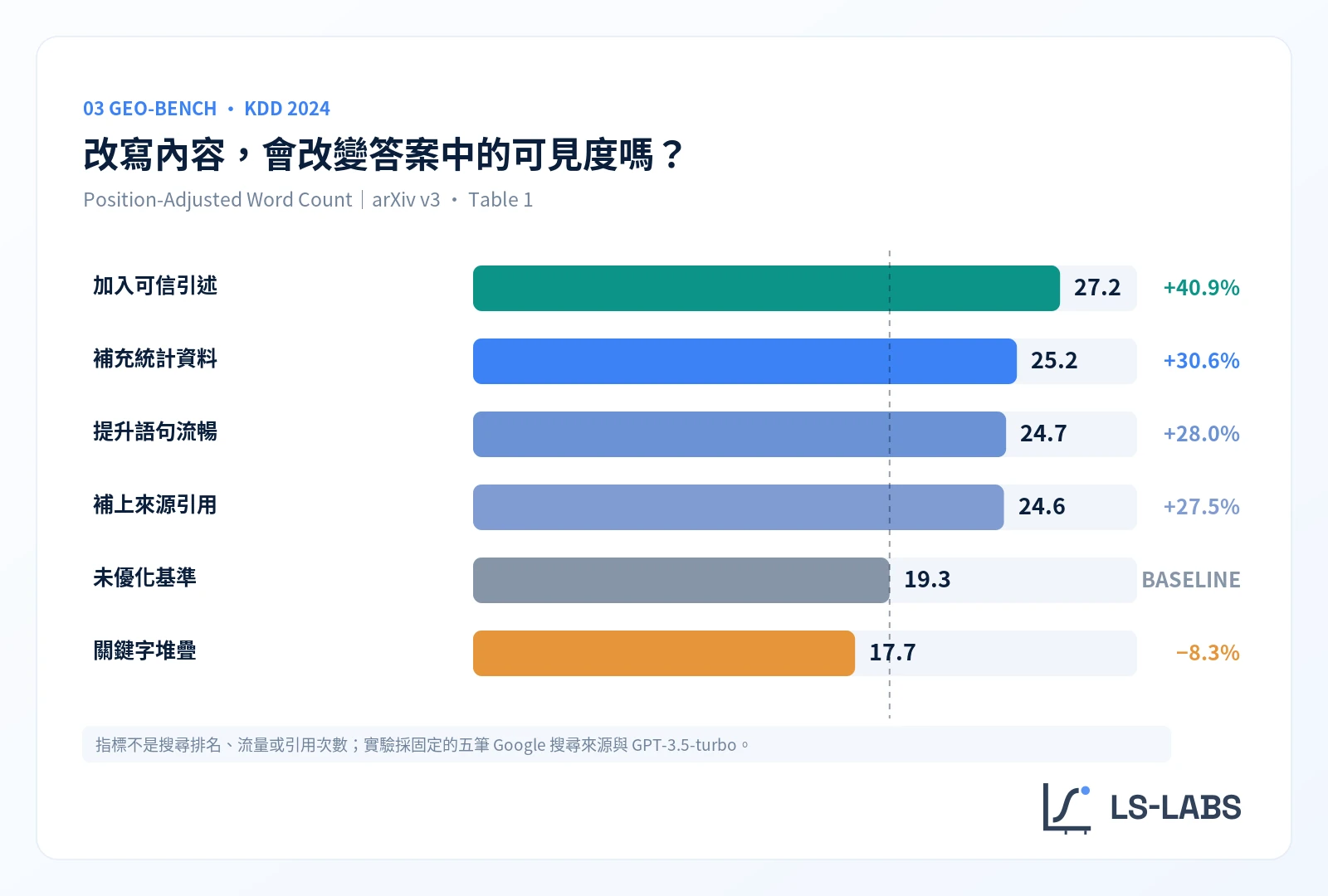
| Content rewriting strategy | Summary of approach | Position-Adjusted Word Count | Change vs. baseline | Subjective Impression |
|---|---|---|---|---|
| Quotation Addition (adding credible quotations) | Add quotations from named sources that relate directly to the topic | 27.2 | +40.9% | 26.9 |
| Statistics Addition (adding statistics) | Replace or supplement vague statements with concrete quantitative evidence | 25.2 | +30.6% | 24.0 |
| Fluency Optimization (improving fluency) | Improve grammatical structure and paragraph readability | 24.7 | +28.0% | 24.7 |
| Cite Sources (adding source citations) | Attach verifiable external sources to claims in the text | 24.6 | +27.5% | 22.2 |
| Unoptimized (unoptimized baseline) | Keep the originally retrieved page content unchanged | 19.3 | Baseline (0.0%) | 19.3 |
| Keyword Stuffing | Deliberately cram in query terms, as in traditional black-hat tactics | 17.7 | −8.3% | 20.2 |
Taking Table 1 together with the paper's later experiments, four conclusions and limits hold up under scrutiny:
- Concrete evidence and clear expression help the model extract and organize its answer: In a fixed candidate pool, adding named quotations (27.2), statistics (25.2), fluency rewrites (24.7) and source attribution (24.6) all clearly beat the unoptimized baseline (19.3). By contrast, simply making the tone more assertive and confident (Authoritative) performed inconsistently across domains and did not show an equally stable gain.
- Keyword stuffing does not help the word-count and position metric, but the evaluation metric itself affects the conclusion: Keyword Stuffing fell to 17.7 on Position-Adjusted Word Count (8.3% below the baseline) and also dropped from 24.1 to 21.9 in the paper's separate 200-question Perplexity.ai test, yet it rose slightly to 20.2 on the GPT-4-scored Subjective Impression metric in Table 1. This is a reminder that a single metric cannot capture every dimension.
- The Perplexity extrapolation is still a controlled environment: In the Perplexity.ai test, Quotation Addition likewise lifted the word-count and position metric from 24.1 to 29.1 (about +20.7%), and Cite Sources improved the subjective impression metric by up to about 37%. But that experiment used file upload to restrict the system to answering from these five texts, which remains far from real users on the open web, where the platform decides the retrieval pool.
- Low-ranked sources can turn things around at the generation stage, but only if they first make it into the candidate pool: In the adversarial setting where multiple sources were rewritten at once, a page originally ranked fifth on Google that adopted Cite Sources saw its word-count and position metric surge by a relative 115.1%, while the first-ranked source fell by 30.3%. This suggests that once a page is in the front part of the candidate list, the generative model weighs the evidence density of the passage itself more heavily. It also corrects a common misconception. As this site's article "When AI search cites AI: synthetic sources and the knowledge feedback loop" verified, this GEO paper never tested "adding an FAQ block" at any point, and Ahrefs' 2026 study tracking 1,885 pages that added JSON-LD structured data likewise observed no significant growth in AI citations.
From relevant to usable: four layers of content work
Putting the semantic retrieval mechanism and the GEO-bench experiment side by side, a site's work in the face of generative search can be broken into four layers, each with a different underlying mechanism and strength of evidence:
Four layers of GEO content review
A page must allow search crawlers to access it and be rendered and indexed normally. If it cannot even enter the retrieval pool at the first gate, no later semantic or evidence rewriting will take effect.
Titles, sections and body text need to state clearly what is being discussed and in what setting it applies. Vector retrieval tolerates paraphrase, but precise proper nouns, brand names and specification descriptions remain important anchors for hybrid retrieval.
Rather than saying in general terms that "companies should take GEO seriously", state the observation period, the design of the test question set, the definitions of mention rate and citation rate, and the sample limits, so the passage itself has enough information density to support an answer.
Keep traceable original papers, links to official documents and verification dates, so that models and human readers alike can tell which sentence is empirical data and which is reasonable inference.
At Layer 1, "discoverable", site owners need to distinguish AI crawlers by purpose. In OpenAI's official documentation, for example, the crawler that builds the index and citations for ChatGPT search is OAI-SearchBot, while the one that collects model training data is GPTBot. A site can allow search retrieval and block model training independently in robots.txt, but if it blocks OAI-SearchBot, its content will not appear as a cited source in search answers (OpenAI, n.d.). For the full trade-offs among crawlers, see this site's article "Should robots.txt block AI crawlers?".
The strongest counterargument to the GEO concept also deserves a direct answer. Google's official 2026 guidance states plainly that, from the way Google Search works, whether outsiders call it AEO or GEO, the core still rests on existing SEO fundamentals and original content quality. Sites do not need to chase every phrasing variant of long-tail questions, nor create an extra llms.txt for Google Search (Google Search Central, 2026).
This official position stands in sharp contrast to treating GEO as a unique shortcut that replaces SEO. Taking the available evidence together, the most practical positioning is to treat GEO as a research framework for observing and improving the visibility and attribution quality of content in generative answers. The retrieval entry point, reranking weights and final citation presentation are still controlled by each platform. What content creators can control is doing discoverability, answer density and verifiability well, and then repeatedly observing the actual changes with a fixed question set.
If an AI attaches a source, does the citation always support the sentence?
After the four layers, one more blind spot is often missed by marketing reports. When an AI answer does attach your URL, or cites an external article to introduce your brand, does that citation marker really support the sentence in the answer?
A Stanford team's paper "Evaluating Verifiability in Generative Search Engines", published in EMNLP Findings 2023, had annotators check, sentence by sentence, the answers of four generative search engines of the time (Bing Chat, NeevaAI, Perplexity.ai and YouChat) against their attached sources (Liu et al., 2023). The results were sobering: on average only 51.5% of generated sentences were fully supported by the citations attached to them (citation recall), and among all the citation links the systems produced, on average only 74.5% actually supported the statement they were attached to (citation precision).
These figures reflect a historical baseline for the systems tested in 2023 and cannot be applied directly as the accuracy of the latest models in 2026. But the structural problem they reveal still exists: citation rate and citation faithfulness are two different yardsticks. A model may attribute things to the wrong source when it merges several web pages, or may rewrite a locally qualified figure from a source into an unqualified universal claim.
This is also why counting only "how many times the brand was mentioned" distorts brand visibility: the model recommending you, citing you as a negative warning, or attaching your official site link while getting the price wrong all count as one impression on the surface, yet their real effect on the brand differs enormously. On this site's GEO research guide and in "How AI search finds local businesses: websites, third-party sources and MCAC", LS-Labs proposes recording four MCAC diagnostics separately (brand mention Mention, source Citation, information accuracy Accuracy, and action readiness Conversion-readiness) rather than merging them into a single total score, precisely so that "whether it was mentioned", "which page it linked to", "whether the facts were right" and "whether the answer offered a next step" can be examined apart.
Conclusion: from being found to being used with evidence
Back to the question at the start: why, of two articles equally close to the question in meaning, does only one appear in the AI's answer?
Vectors and dense retrieval explain the first half. Embeddings let a search system cross differences in surface wording and quickly recall candidates with similar meaning from tens of millions of passages. But cosine similarity does not fact-check an article, does not weigh the strength of evidence, and cannot guarantee that the generative model credits the correct source when it rewrites the answer.
If traditional search made content owners care about "whether users can see this link on the results page", generative search adds a question they must also ask: "what information did the system take from this page, was it right, and who did it credit with the citation?" And when user needs move beyond looking up information to asking an AI agent to book a table, compare prices or call a service directly, the arena extends further to TSO (Tool Selection Optimization) and AX (Agent Experience).
For site owners, understanding semantic retrieval is never a reason to abandon SEO fundamentals. For researchers, a single vector formula should not be treated as a cure-all that works across platforms. When a question is rewritten and expanded, candidate passages go through hybrid retrieval and reranking, and a language model finally reassembles them into an answer, only content that has a retrievable structure, concrete answer density and verifiable primary sources has stronger grounds to leave a clear and faithful citation trail in generative answers.
References and official sources
Academic papers
- Reimers, N., & Gurevych, I. (2019). Sentence-BERT: Sentence embeddings using Siamese BERT-networks. In Proceedings of the 2019 Conference on Empirical Methods in Natural Language Processing and the 9th International Joint Conference on Natural Language Processing (EMNLP-IJCNLP) (pp. 3982–3992). Association for Computational Linguistics. https://aclanthology.org/D19-1410/
- Ethayarajh, K. (2019). How contextual are contextualized word representations? Comparing the geometry of BERT, ELMo, and GPT-2 embeddings. In Proceedings of the 2019 Conference on Empirical Methods in Natural Language Processing and the 9th International Joint Conference on Natural Language Processing (EMNLP-IJCNLP) (pp. 55–65). Association for Computational Linguistics. https://aclanthology.org/D19-1006/
- Karpukhin, V., Oguz, B., Min, S., Lewis, P., Wu, L., Edunov, S., Chen, D., & Yih, W.-t. (2020). Dense passage retrieval for open-domain question answering. In Proceedings of the 2020 Conference on Empirical Methods in Natural Language Processing (EMNLP) (pp. 6769–6781). Association for Computational Linguistics. https://aclanthology.org/2020.emnlp-main.550/
- Lewis, P., Perez, E., Piktus, A., Petroni, F., Karpukhin, V., Goyal, N., Küttler, H., Lewis, M., Yih, W.-t., Rocktäschel, T., Riedel, S., & Kiela, D. (2020). Retrieval-augmented generation for knowledge-intensive NLP tasks. In Advances in Neural Information Processing Systems (NeurIPS 2020) (Vol. 33, pp. 9459–9474). https://arxiv.org/abs/2005.11401
- Khattab, O., & Zaharia, M. (2020). ColBERT: Efficient and effective passage search via contextualized late interaction over BERT. In Proceedings of the 43rd International ACM SIGIR Conference on Research and Development in Information Retrieval (SIGIR '20) (pp. 39–48). ACM. https://doi.org/10.1145/3397271.3401075
- Liu, N. F., Zhang, T., & Liang, P. (2023). Evaluating verifiability in generative search engines. In Findings of the Association for Computational Linguistics: EMNLP 2023 (pp. 7001–7015). Association for Computational Linguistics. https://aclanthology.org/2023.findings-emnlp.467/
- Aggarwal, P., Murahari, V., Rajpurohit, T., Kalyan, A., Narasimhan, K., & Deshpande, A. (2024). GEO: Generative engine optimization. In Proceedings of the 30th ACM SIGKDD Conference on Knowledge Discovery and Data Mining (KDD '24) (pp. 5–16). ACM. https://doi.org/10.1145/3637528.3671900 (Table 1 and the figures in this article were checked against Tables 1, 3 and 5 and the appendix of arXiv:2311.09735v3.)
Official technical documentation and industry research
- Google Search Central. (n.d.). AI features and your website. Google Developers. https://developers.google.com/search/docs/appearance/ai-features?hl=en
- Google Search Central. (2026). Optimizing your website for generative AI features on Google Search. Google Developers. https://developers.google.com/search/docs/fundamentals/ai-optimization-guide?hl=en
- OpenAI. (n.d.). Overview of OpenAI crawlers. OpenAI Developer Platform. https://developers.openai.com/api/docs/bots
- Linehan, L., & Guan, X. (2026, May 11). We tracked 1,885 pages adding schema. AI citations barely moved. Ahrefs. https://ahrefs.com/blog/schema-ai-citations/
References and official documents were last checked on 4 November 2026. AI tools were used for coding assistance and language editing. The author reviewed the research design, verification, interpretation and final conclusions.